Saturday, March 17, 2012

GameFest

The Smithsonian has a serious ghost infestation.
Days like today don't come around too often.

Today was day two of GameFest, a three day celebration of video games at the Smithsonian American Art Museum. The weekend extravaganza kicks off a seven month exhibition called "The Art of Video Games" that should be very well attended, if today's audience is any indicator. It was absolutely wonderful to be in the company of so many video game fans from all over the country, representing many different age groups. It was an honor to sit and listen to living legend Hideo Kojima talk about his craft. And it was thrilling to see some of my favorite video games, indeed any video game, on display at a Smithsonian museum. Video games have come a long way over the past 40 years.

Note: photographs that didn't make it into this post can be viewed by clicking on the picture below.

GameFest 2012

There was plenty to see and do at GameFest, but the highlight was a one-hour conversation between guest curator Chris Melissinos and producer/director Hideo Kojima, most famous for the Metal Gear Solid series. I was lucky enough to get two tickets to the sold-out show. Kojima spoke (via a translator) about his career as a video game developer, his dreams of becoming a filmmaker at an early age, and his opinions about video games and their place in popular culture, society, and art. One of Kojima's most intriguing remarks followed a question from Melissinos about comments Kojima made in 2006 that video games were not art. Kojima used some rather ambiguous language in his answer, I think to avoid saying explicitly that he still feels the same way, but also admitted that video games represent a composite of several different artistic forms, and "interactive" art. His answer was very nuanced and very sophisticated, and I cannot do it service here, but suffice it to say that it made me think long and hard about my own definition of art, and how that definition applies to video games.

From left to right: Sean Eyestone, Hideo Kojima, and Chris Melissinos.

Other highlights of GameFest included video game kiosks, live video game music, and "Live Action Gaming," all set up in the courtyard at the museum. Live Action Gaming was particularly hilarious. Guests at the museum basically walked through a live-action video game, complete with obstacles and enemies, accompanied by video game sound effects. It had to be seen to be believed.

Mario's job is safe for now.

Then there was the exhibit, which thankfully will be around for several months. The line was rather long – it took about 40 minutes to get in – but it moved quickly and I had time to strike up a conversation with a couple of very nice fellow video game fans. The exhibit fills several rooms, one with videos, screen grabs, and concept art; one with video game demos; and one with interactive kiosks chronicling the last seven generations of video gaming. The latter were my favorite. Each kiosk represented a system, and displayed information about four of its landmark games. It was interesting to watch guests flock to their favorite systems and admire their most treasured games.

Hello? Yes, I AM interested in long distance savings. VERY interested.

The best thing about The Art of Video Games is its replay value. Get it? See what I did there? I could easily visit the museum every weekend for the next month, testing out each demo, and listening to the history behind games like Doom, Mass Effect 2, and Final Fantasy VII.

In the end, it was a real honor to share the artistic medium I love with other kindred spirits, young and old. Like Kojima said in his panel, video games have arrived at a place where they rival other, long-established media much sooner than expected. I can't wait to see where they go next.


__________________________
Photographs by Elizabeth Frazier

Wednesday, March 14, 2012

Weird Video Game Habits

I recently stumbled upon a feature at 1UP.com titled “You’re not Alone: Gamers Share Their Quirky Playing Habits,” and it got me thinking. What quirky video game habits have I developed over the past two decades?

Well, for starters I’m a bit of a completist, and this involves not only how I play in video games, but which video games I play. I need to play every game in a franchise, in order, even if the games are unrelated in terms of story. Oh, and I HAVE to read the manual for each game, cover to cover.

Those are the easy ones.

Then, once I boot up a game, I try my best to find everything I can, every secret room, every hidden trinket, every ammo cache. This behavior probably peaked in the mid to late 1990s when games like Super Mario 64 and Banjo-Kazooie had literally hundreds of stars, coins, notes, and jinjos to collect. In fact, I was so obsessed with finding one last musical note in Banjo-Kazooie that I stopped playing out of frustration and only finished the game a decade later when I picked it up again and decided it was OK not to get 100% completion. Lately, because I play SO many games, I can’t devote myself so tenaciously to individual titles, but I still try to uncover everything I can. While playing Symphony of the Night, I backtracked through a significant section of the map because I noticed the corner of one room hadn’t been explored. Nothing was there, but it would have driven me crazy not knowing.

Perhaps the pistol wasn't the proper weapon in this situation.

I’m also a conserver, although you could call me a hoarder. Whenever I find money or special ammo or a powerful potion I tend not to use it immediately, saving it for a super-strong enemy or situation that sometimes never appears. At the end of Symphony of the Night, I had in my inventory dozens of unused potions, projectile weapons, and food items. However, this idiosyncrasy started long before that. I remember playing Turok and Turok 2, and blasting enemies with my pistol for as long as I could to save ammo for my shotgun, assault rifle, grenade launcher, etc. Ammo wasn’t exactly in short supply, but I never wanted to use that ammo unless absolutely necessary. Then there's the house I was using in Morrowind to store tons of weapons, armor, books, and other accessories that I couldn't sell. It looked like a treasure chest had exploded.

I'll take the one on the left.

If there is a game where morality is a factor, I NEED to swing all the way to the morally right side of the scale. In games like Mass Effect, Fable, and Jade Empire I make my avatar a paragon of virtue. He or she does no harm, always gives up the payday to help out the needy, and never, ever kills in cold blood. I’ve considered going back and playing through some of these RPGs as an evil character, but I can’t bring myself to do it.

I’m also a compulsive checker. I always, ALWAYS look under every staircase. And I try to walk or swim through every waterfall. And God help me if I walk into a locker room, or a hallway full of closed doors.

It's good advice.

So that’s me. What video game quirks do you have? Do you need to finish every quest in an RPG or do you need to take a particular route when given the decision? Do you have to play on easy the first time through a game? Do you feel compelled to unlock every achievement? Are you a compulsive reloader? Tell us in the comments section.

Monday, March 12, 2012

Castlevania: Symphony of the Night

The Belmonts take a back seat in this epic journey through Dracula’s castle.

Every now and then a long-standing franchise will reinvent itself, and the gaming world gets hugely important titles like Grand Theft Auto III, Resident Evil 4, Call of Duty 4: Modern Warfare, and The Legend of Zelda: Skyward Sword. For the Castlevania franchise, that reinvention was Symphony of the Night, a 1997 game that breathed new life into the series and influenced a generation of Castlevania games. Without Symphony of the Night, we wouldn’t have titles like Circle of the Moon, Aria of Sorrow, and Portrait of Ruin, to name a few.

Symphony of the Night (SOTN) is the sequel to Castlevania: Rondo of Blood, a Japan-only release that pitted Richter Belmont against the forces of evil. Five years after the events in Rondo of Blood, Richter has gone missing and Dracula’s castle once again looms like a curse over the land. In a break from tradition, the protagonist of SOTN is not one of the Belmont clan, but rather Alucard, the dhampir son of Dracula who was first introduced in Castlevania III: Dracula’s Curse.

SOTN established a new gameplay style for the Castlevania franchise that in many ways resembled Super Metroid, which led critics to coin the terms “Castleroid” and “Metroidvania.” Instead of the linear levels that largely defined the series before 1997, SOTN drops players into a huge castle, sections of which are inaccessible at first. As players explore monster-filled rooms, uncover secret passageways, and discover hidden relics, more and more of the castle becomes available. By pressing select on their controllers, players can view a blueprint of the castle, including all rooms already visited. This is a far cry from the stage-by-stage structure of earlier Castlevania games, with the exception of Castlevania II which was also non-linear.

Alucard faces off against a minotaur and werewolf.

SOTN also added role-playing game elements to the mix. Alucard has hit points and magic points, which determine how many enemy attacks he can withstand and how many magic spells he can perform, respectively. Moreover, as Alucard defeats more and more enemies, his experience points rise and he levels up, increasing his strength, constitution, intelligence, luck, etc. Players can also equip him with literally dozens of weapons, armor pieces, and accessories that enhance his attack power, defense, and resistance to elemental attacks.

A brief note on Alucard before I continue: he is an exceptional video game hero. Brave, complicated, tortured, Alucard deserves to be mentioned in the same breath as Samus Aran, Gordon Freeman, and Solid Snake.

The status screen in Symphony of the Night.

Ok, back to SOTN. It plays like a dream. Controls are tight, the story is presented poetically, and the castle itself is stunning, despite graphics that are not exactly high-powered. Castle backgrounds are especially beautiful, with a clever combination of 2D and 3D effects. SOTN is also perfectly paced; if it wasn’t for physical demands like sleep and food intake, I could easily have played straight through for 12 hours.

The best part of SOTN, however, is its music. It has, arguably, the best video game soundtrack of all time. I write this without hyperbole. Each track is unique, gorgeous, catchy, and flawlessly orchestrated. Moreover, it is incredibly varied. Tracks contain elements from jazz, techno, classical, and rock. Standout tracks include "Dance of Pales," "Lost Painting, " and "Dracula's Castle." Music was composed by Michiru Yamane, who is most famous for her work on Castlevania and Suikoden games.

Death threatens his master's son.

In the end, SOTN is a terrific, landmark title that really should be played by everyone who appreciates video games, not just fans of the franchise. It was years ahead of its time, and is responsible for some of the best games on the Game Boy Advance and Nintendo DS. There is so much to explore and uncover in Dracula’s castle, including a staggering number of secret areas and Easter eggs, that a single play-through will probably be insufficient. Is it the best Castlevania ever, as many fans and critics argue? I’d probably save that title for Aria of Sorrow, but SOTN is a very close second.


Score: 9.5


Note: SOTN has become something of a collector’s item since its release, and is rather expensive on eBay and other similar sites. If you have a PS3 or Xbox 360, you can download a port of the original game for about $10. I recommend the PS3 port, as it is identical to the Playstation original.

Thursday, March 8, 2012

Research Shows Video Games Good for You, Probably

Our future overlords?
Video games are cool. That's just science. But now there is a growing amount of research that shows video games might affect our bodies and brains in beneficial ways, like enhanced hand-eye coordination and improved night driving ability, which would be useful if video game players actually left the house at night.

What is most remarkable is that action games, and particularly the most violent (and controversial) action games, are the ones that produce the greatest effects: people who played action games were able to make decisions 25% faster than others, without sacrificing accuracy.

One of the studies, a three-year examination of 491 middle school students, found that those students who played more computer games achieved greater scores on standardized creativity tests, regardless of race, gender, or even the type of game played. This begs the question, however: are creative young people playing video games, or are video games making young people more creative?


Frankly, I'm not the kind of person who will be moved very much by this research. If a study came out tomorrow that said video games cause terrible, nightmarish diarrhea, I'd probably still keep playing them. But maybe this will calm down some of the reactionaries out there who are either bent on banning video games altogether or reducing the video game market to a cottage industry pumping out games like "ChurchVille," "Don't Run With Scissors," and "Good, Clean Fun: Best Friends Edition."

Wednesday, March 7, 2012

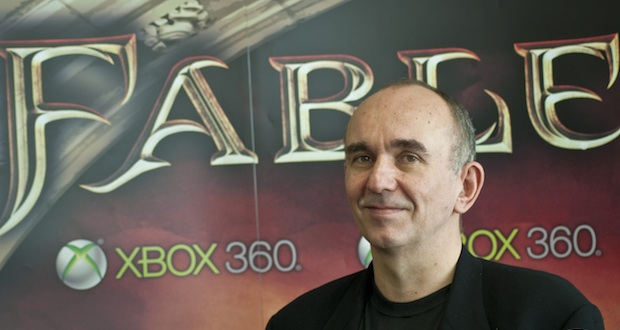
Peter Molyneux Leaving Lionhead, Microsoft

Peter Molyneux
Famed video game designer Peter Molyneux announced he will leave Lionhead Studios after the completion of Fable: The Journey, which will launch later this year. He will also leave Microsoft Games Studios Europe, where he is creative director.

Molyneux, 52, is the creative force behind Populous, the 1989 computer game that invented the "God game," Black & White, and, most recently, the Fable franchise. He is certainly one of the most gifted and respected game designers of his or any generation. He will be succeeded at Lionhead by Mark Webley, who co-founded that company with Molyneux. Microsoft has not yet named a replacement.

Molyneux also announced that he will launch a new video game studio, 22 Cans. If history teaches us anything, Molyneux will make a handful of ambitious, important games with his new studio, sell it to an interested party, and move on to bigger and better things. He did it first with Bullfrog Productions (sold to EA), then with Lionhead Studios (sold to Microsoft following the success of Fable).

From the press release:
"It is with mixed emotions that I made the decision to leave Microsoft and Lionhead Studios, the company that I co-founded in 1997, at the conclusion of development of Fable: The Journey."
"I remain extremely passionate and proud of the people, products and experiences that we created, from Black & White to Fable to our pioneering work with Milo and Kate for the Kinect platform. However, I felt the time was right to pursue a new independent venture."

Monday, March 5, 2012

Call of Duty: Modern Warfare 2

Infinity Ward tackles single player, co-op, and multiplayer – and aces them all. 

Ready for some controversy? Call of Duty: Modern Warfare 2 has the absolute best package of the three main components of video gaming – single player, cooperative play, and multiplayer – in the history of the industry. The operative word here, of course, is package. Independently, each component in Modern Warfare 2 (MW2) is not the best of all-time (although an argument could be made for its multiplayer component), but together the package is unparalleled. Few developers have attempted to tackle all three components with much seriousness, and even fewer have produced a menu like that found in MW2, which is polished, deep, and addictive across the board.

MW2 is a direct sequel to Call of Duty 4: Modern Warfare, which catapulted the Call of Duty franchise into the stratosphere. If you didn’t play the first game, the plot, characters, and contingents in MW2 will be somewhat confusing. In fact, the storyline in MW2 is so convoluted that even Call of Duty veterans might scratch their heads. As in previous installments, the campaign in MW2 follows several protagonists on military operations across the globe. Two of the most memorable include a stealth infiltration of an offshore oil rig, and an all-out assault on a Russian prison complete with a shower room gun battle that plainly evokes The Rock. There are several unexpected twists and turns along the way, which will not be mentioned here.

The tutorial in Modern Warfare 2.

The main campaign mode, however refined, varied, and emotionally powerful, is short – only six hours long – but Infinity Ward prepared for its consumers a wealth of content beyond the single-player campaign, including a brand new cooperative mode called Special Ops and an updated version of its addictive online multiplayer. Special Ops is a real treat for fans of co-op. Played online or via splitscreen, Special Ops features 23 short missions – three to fifteen minutes long – that can be tackled individually but are much easier and more fun with a partner. Missions are usually set in areas borrowed from the main campaign, and include operations like assault, wave defense, elimination, stealth, etc. Two of the most unique and enjoyable missions are “Overwatch” and “Big Brother,” both of which can only be played with two people. In “Overwatch” one player runs on foot from a crash site to an extraction point, while the other player controls a C-130 Hercules, a military transport aircraft. The C-130 can fire shots at incoming helicopters, jeeps, and enemy troops before they reach the soldier on the ground. “Big Brother” is similar, except the C-130 is replaced by a helicopter with a Vulcan minigun. Communication and good teamwork are essential in “Overwatch” and “Big Brother,” indeed in all Special Ops missions.


The star of MW2, however, is its multiplayer component, which is incredibly deep and habit-forming. MW2 retains the experience point and ranking system from the first Modern Warfare. Experience points are earned by killing players, completing objectives, winning rounds, etc. These can then be used to unlock new weapons, perks, and modes. In MW2, however, advanced players have the option to customize their “killstreaks,” which are earned after a requisite number of consecutive kills. Thus, veteran players in MW2 clearly have a huge advantage and, conversely, rookie players a significant disadvantage. So multiplayer is a double-edged sword.

Taken together, the single player, cooperative, and multiplayer modes in MW2 are unlike any other video game combination in terms of depth, diversity, and pure fun. Although the campaign is relatively short, Special Ops and especially online multiplayer will keep players busy for months, if not years.


Score: 9.5

Friday, March 2, 2012

Monster Hunter

Gotta hunt ‘em all.

There is something very primordial, very instinctual about Monster Hunter. Here is a game that asks its players to pluck out resources from the earth, capture and destroy fearsome, deadly animals, claw their way to the top of the food chain, and otherwise tame the world around them. Along the way, players will forge mighty weapons and armor from animal bones and skins, combine everyday ingredients to create rare concoctions, and buy, sell, and trade with merchants and fellow hunters. Altogether, Monster Hunter evokes prehistory. Simply put, it is man versus nature. And it’s a war of attrition.

Monster Hunter is an action game that was meant to be played online and offline. However, because Capcom shut down their North American servers in 2007, I can only report on Monster Hunter’s offline component, which, according to the vast majority of reviewers, is inferior. Even so, I can confidently state that even offline, and without the help from fellow players around the world, Monster Hunter is a game worth playing. The rewards are smaller and arrive with less frequency offline, but those who are patient can still find a challenging, gratifying experience.


There isn't much story in Monster Hunter. Players custom create an avatar at the very beginning of the game, and modify his weapons, armor, and accoutrements throughout, but there are no plot developments to study, no character development to speak of. Monster Hunter is a series of quests that must be conquered to move forward in the game. It's not unlike a MMORPG, although players in Monster Hunter cannot level up, nor can they freely roam an open-world environment. Instead, each quest starts from a base camp and spills out into several zones, some dessert, some forest, some swampland. The three main quest types include hunt, gather, and capture. In hunting quests, which make up the majority of the challenges in Monster Hunter, players must track and kill animals, large and small. Gather quests ask players to collect ingredients, for example mushrooms or animal livers. And capture quests, among the most challenging, demand players weaken a monster and capture it in a trap, but not destroy it.

This was me a lot of the time.

The most obvious and glaring problem with the offline quests is that many of them are far too difficult to complete alone unless one plays lower level quests again and again to earn money and materials to make stronger weapons and armor. Even then, the most deadly monsters in the game, wyverns, are sometimes impossibly difficult. I think the developers at Capcom meant for the offline component to be more of a tutorial than a full game, and packed most of the material into the online component.

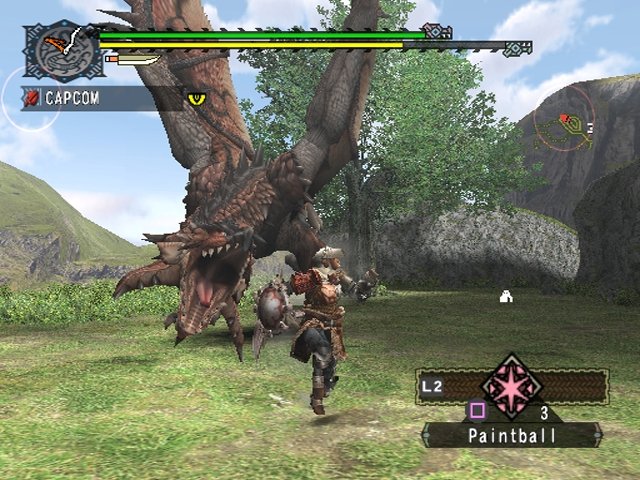
Graphics in Monster Hunter aren’t the most gorgeous you’ve ever seen, but when it comes to art direction, the game is something to behold. From foggy, humid jungles, to sun-baked desserts, each area feels genuine and unique. The forest and hills section of the game is probably the best example of this expert art design: tall, grassy mountains scrape the sky in the background while white, wispy clouds float overhead. Sound design is also especially good in Monster Hunter and only adds to the ambiance. A wyvern’s roar in the distance is genuinely alarming.

Forest and Hills

In general, controls work perfectly fine in Monster Hunter with one big exception. Hunters swing their weapons – whether sword, lance, or hammer – with the right analog stick. This is one of my least favorite control scheme decisions in general in video games, if only because swinging a weapon with an analog stick instead of buttons feels unnatural and unwieldy. After enough practice, swordplay in Monster Hunter becomes more effortless, but it’s still a poor design choice.

Overall, I enjoyed almost all of my time playing Monster Hunter, minus the hours that were spent in tedious trial and error. The game provides its players with a real sense of accomplishment, whether by finding rare ingredients and forging strong armor, or by defeating a powerful monster. I regret I was unable to play Monster Hunter’s online quests with other real-life players, but even offline the game is fun to play, and gratifying. Monster Hunter as a franchise is still going strong, especially in Japan, and I look forward to playing many more installments.

Score: 8.0